
What Happens When a Ghostwriter Takes Over Your Newsletter?

This is a question I get from almost every founder I talk to: “will it actually sound like me?”
It's a fair question. A reasonable one. Your newsletter is one of the most personal things you can publish under your name. It's supposed to sound like you think, not like someone else thinks on your behalf. The idea of handing that over to someone you've just met, someone who doesn't know your industry the way you do, doesn't have your history, doesn't speak the way you speak — feels risky.
So let me tell you exactly what happens.
It Starts With a Call
This is non-negotiable for me because no document you fill out will tell me what I actually need to know about you. A call tells me how you think. How you explain things. Whether you speak in long, winding sentences that loop back on themselves or short, punchy ones that land and move on. Whether you're formal or casual, whether you swear, whether you laugh at your own jokes, whether you hedge your opinions or state them plainly.
I'm not just listening to what you say. I'm listening to how you say it.
I ask about your goals, your vision, what you're building and why. What you want your audience to feel when they read your newsletter, what you've already tried and what hasn't worked, what you'd say about your industry that most people in it avoid for some reason.
Somewhere in that conversation, I get a feel for who you actually are. That's what I'm there for.
Then I Do My Homework.
After the call, you send me things. Past newsletters if you have them. LinkedIn posts. Emails you've written. Notes. Anything that already exists in your voice.
I read all of it to find patterns, to understand the way your mind connects ideas.
Voice isn't just tone. It's a whole set of variables — vocabulary, rhythm, sentence length, how you open paragraphs, what you find funny, what you take seriously, what you let slide and what you don't. A good ghostwriter is reading for all of it.
I also read what your competitors are writing. What others in your industry are saying. Not so I can mimic them, but so I can understand what makes your perspective different from theirs, what the gap is that your voice can fill.
I started working with a tech founder in December 2025. She was building a new platform, had a clear vision, and a Substack that had 18 subscribers when we began. She knew what she wanted to say. She just didn't know how to write or the energy or time to be consistent.
So, we hopped on a Zoom call.
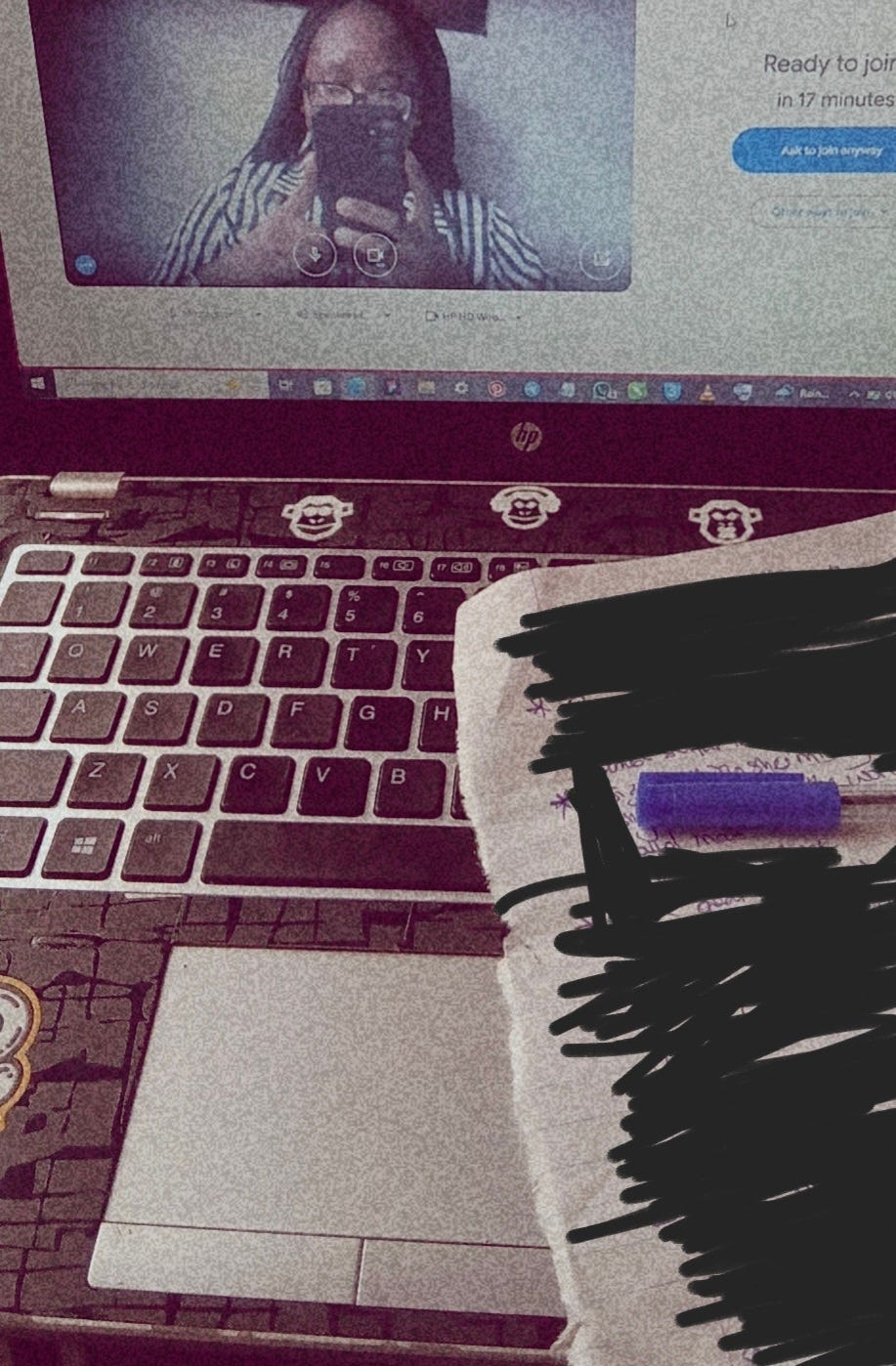
(Came with some questions and took down some notes.)
We had a conversation, I got my questions answered, she got answers to her questions as well. And I left with clarity.
She's close to 200 subscribers now with few prospects for what she is trying to build. She achieved this by posting one article weekly with no audience funneled from outside—all substack organic growth.
What Most People Get Wrong About Ghostwriting.
The biggest misconception is that ghostwriting means the ghostwriter disappears entirely and magically produces content that sounds exactly like you from day one, with no input required on your end.
That's not how it works and any ghostwriter who tells you otherwise is setting you up for disappointment.
Good ghostwriting is collaborative. It requires you to show up—send voice notes when you have an idea. To tell me when something doesn't feel right. To be willing to have a conversation about what you actually think about something rather than what the safe version of that thought looks like.
The founder who gets the most out of a ghostwriting relationship is the one who treats it like a partnership rather than a vending machine. You put ideas in. You get writing out. But the ideas have to come from somewhere real — from you, from your experience, from the way you see your industry.
What I bring is the writing. The structure. I help you write what you couldn't quite find the words for. I help you create a newsletter that actually gets sent instead of sitting as a draft for three weeks while you try to find time to finish it.
What you bring is the perspective and the knowledge. The point of view that nobody else has because nobody else has lived your professional life.
Neither of those works without the other.
I understand why founders are skeptical. Ghostwriting is a quiet industry. Most of it happens behind NDAs. You can't always see the proof because the proof is published under someone else's name and the ghostwriter isn't allowed to say so.
What I can tell you is this: the concern about it not sounding like you is a real thing to be concerned about, but it's solvable. It gets solved through the onboarding process — the call, the documents, revision and clear feedback. Through a ghostwriter who is actually listening rather than just producing.
The founders who don't get what they're looking for from ghostwriting are usually the ones who hand everything over and disappear. They want a ghostwriter who needs nothing from them, who can read their mind and produce perfect content in a vacuum. Goodluck with that.
The founders who do get what they're looking for are the ones who stay involved in the right ways. Who give feedback, who share what they're thinking about, who treat the ghostwriter like a writing partner rather than an invisible employee.
What the Newsletter Looks Like After.
First thing is consistency. Published newsletters every week(one or twice a week or even more) in your voice, to an email list that is slowly starting to expect it, open, read, comment or share. The newsletters start to represent you and over time, your readers begin to feel like they know you because the newsletter sounds like a person with opinions, a way of seeing things and a consistent voice.
That's what a newsletter ghostwriter is actually for—I don't only write things, I make sure your voice gets into the world consistently enough that it starts to do what a voice is supposed to do.
If you have ideas and no time to turn them into writing that actually sounds like you, that's exactly what I do.
Reach out: idowuf42@gmail.com
interesting take, but i find that the real test is long-term authenticity 🥲. been there, done that. readers who usually follow a founder closely may eventually sense a disconnect between the newsletter voice and how that person actually communicates in interviews or on social media. the collaborative model helps tho...a long way, but it's not a perfect substitute for writing in your own hand.